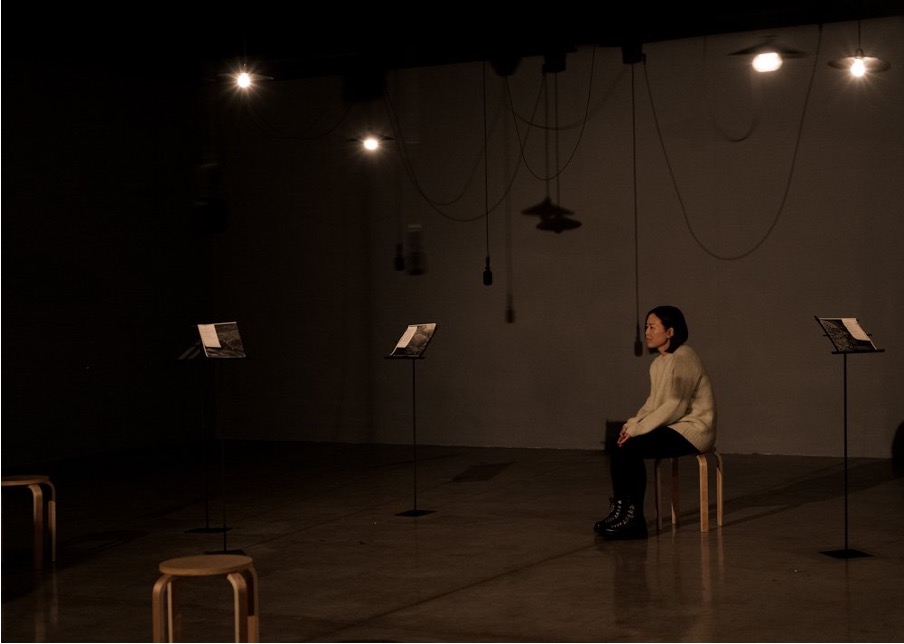
Shilpa Gupta, Listening Air
Installation view at Tanya Bonakdar Gallery, New York, 2023
Photo by Tanya Bonakdar Gallery
Image courtesy of Ishara Art Foundation and the artist
Link to image
Oof, I hear you, talking about work is hard. Most of us have had those conversations where you reach out, hoping for relief, and instead you leave feeling more alone with your problem.
Part of the challenge is that work isn’t just work. For some, it’s a job they tolerate; for others, it’s participating in a high-control, political machine that demands far more than outsiders can imagine. Trying to explain surviving in some corporations is a little like trying to describe the rituals and complex feelings of a practicing Catholic to someone who has only ever walked outside a Cathedral. It’s especially hard to translate into words if you have a highly resonant body – a finely tuned instrument for sensing the use of power and control in human relationships. You might be able to feel that something is off, but you haven’t quite figured out what it is and why it’s bothering you so much. Would it be ok if we called this problem ‘crap conversations’?
I imagine these ‘crap conversations’ could be making you feel as if it’s no use to try and talk to people? If your workplace has such a harsh culture around putting up and shutting up with injustices, it’s probably not realistic to search for a safe colleague who will understand your situation perfectly. But it’s also not true that everyone in your life is completely unable to empathise with you. So I’m wondering if it could help to identify what might be missing in these ‘crap conversations’ so you can strengthen them with the people who do care about you?
Let’s go through some familiar responses and unpack them a bit…
“Don’t let it get to you.” You are not too sensitive if something feels off. It’s why you are a human and not a robot, because things can get to you. If you’re talking to someone who does care, you might try naming it upfront: “This really got to me. Can you sit with me in my [insert feeling] today?”
“Life’s too short — just get another job.” Sounds easy, right? But jobs aren’t shirts you change. There’s a whole life, identity, and sacrifice stitched into them. When someone brushes that off, it can belittle everything you’ve built. One option is to gently redirect: “Life’s complicated. I’m not changing jobs right now — I just need to talk through what I’m dealing with.”
“You sound depressed — maybe see your GP.” Ouch. This especially hurts when you’re just having a sane response to a messed-up situation. If it feels useful, you could say: “Sometimes I just need space to talk about my work and how it makes me feel. Anyone would sound a bit down after what I’ve been through today.”
Even well-meaning people can need reminding: you are not the problem to be fixed, you’re the person they care about who is inside a problem. And I think that reveals the real hole in most conversations about work – we often gloss over the context of capitalism, gender roles, and power that aren’t abstract theories; they’re like weather systems. They decide how much sun, water, and nourishment a plant gets. To blame the plant for struggling in a drought is absurd — yet that’s exactly what happens when we talk about work without naming the systems around it.
In wrapping up these thoughts, here are a few questions you might like to consider about yourself:
- If you could speak to anyone about your work, totally risk-free & all your secrets kept, who would it be and why?
- What’s so appealing about speaking to that person, and how do you think that conversation would make you feel?
- What skills are you bringing by discerning the person you would approach for this imaginary conversation? What other skills have you used to look after yourself while you’re going through tricky times without the perfect confidant?
My guess is that this challenge of ‘crap conversations’ and your work story is just a small part of the wonderful multitudes that make up you. With a few ideas to keep conversations in a compassionate space, and the context you could place your challenges in, even little shifts can make a huge difference to your connection to others. We can survive so much when we aren’t walking alone.
I’ll leave you with a quote:
“We can begin the process of making community wherever we are. We can begin by sharing a smile, a warm greeting, a bit of conversation; by doing a kind deed or by acknowledging kindness offered to us. Doing this we engage in love practice […] we lay foundation for the building of community with strangers. The love we make in community stays with us wherever we go. With this knowledge as our guide, we make any place we go, a place where we return to love.”
bell hooks, All About Love: New Visions